Saltwater
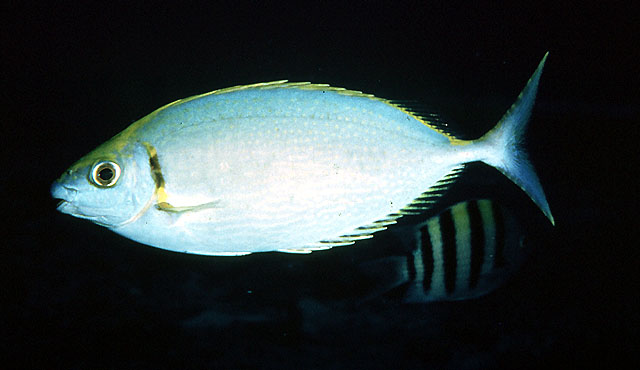
Streamlined spinefoot
Siganus argenteus
Siganidae
Siganus argenteus
Siganidae
Know what is missing? Suggest it in the app.
Lives wild in American Samoa, Australia, Cambodia, Cocos (Keeling) Islands, Cook Islands, Fiji, France, French Polynesia, and 38 more countries.
Inhabits coastal and inner reef slopes and lagoons. Usually occurs in large schools that swim fast and well above the substrate, occasionally all diving down to the bottom to feed. Juveniles and adults occur in small schools (2-100) around coral reefs, typically in surge zone at reef edge. Juveniles live near the surface in dense aggregations up to several km offshore, migrating to reef flats just prior to metamorphosis. Feeds on algae. Juveniles and adults not frequently found in markets; but prejuveniles form a brief but important fishery when migrating on to the reef flat, e.g. combined catch (with Siganus spinus of 16 tonnes in one season in Guam. Prejuveniles eaten fresh, pickled in brine or made into fish paste. Consumed as food although it is known to be occasionally poisonous. Used in Chinese medicine.
From the store to the tank: how to get the fish used to your water, why you should add only a few at a time, and what to watch for in the first few days.
Why new fish should live in a tank of their own for a few weeks before they move in, what you need, and what to look for.
What is different in a saltwater aquarium: salt, refractometer, live rock and corals. An introduction for anyone thinking of giving it a try.