Saltwater
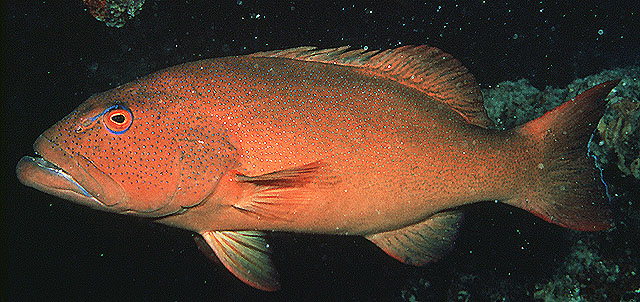
Leopard coralgrouper
Plectropomus leopardus
Epinephelidae
Plectropomus leopardus
Epinephelidae
Know what is missing? Suggest it in the app.
Lives wild in Australia, Brunei, China, Cocos (Keeling) Islands, Fiji, Hong Kong SAR China, Indonesia, Japan, and 14 more countries.
Inhabit coral-rich areas of lagoon reefs and mid-shelf reefs. Solitary. Inactive at night, hiding under ledges. Juveniles have a demersal existence in shallow water in reef habitats, especially around coral rubble. Adults feed mainly on fish, juveniles feed on small fish and invertebrates such as crustaceans and squid. A protogynous hermaphrodite. Form several spawning aggregations on a reef occurring around the new moon. Eggs float just below the surface. Larvae are pelagic. P. leopardus is used in cage culture; P. maculatus in Ref. 3081 was probably a mixture of P. maculatus and P. leopardus; the Plectropomus sp. used for the experiments reported in Capra et al., 1988 consisted predominantly of P. leopardus, with some P. maculatus (M.F. Capra, pers. comm.). On the Great Barrier Reef, its maximum lifespan is 14 years.
Temperament, fin nippers, fish that eat other fish, and fish that need the same water. And what the Harmony mark in the app means.
From the store to the tank: how to get the fish used to your water, why you should add only a few at a time, and what to watch for in the first few days.
Why new fish should live in a tank of their own for a few weeks before they move in, what you need, and what to look for.
What is different in a saltwater aquarium: salt, refractometer, live rock and corals. An introduction for anyone thinking of giving it a try.